Nicab Ltd
A Lean Success Story
DRIVING EFFICIENCY IN BUSINESS
APPLIED
LEAN
CONSULTING
- Home
- nicab
PROJECT DETAILS
Nicab Ltd
Nicab manufacture cable assemblies for medical, industrial and other specialised business sectors from their site in Silverstone Park. With a staff of 25 and a turnover of around £3.5M, the business was experiencing many of the common challenges found within growing manufacturers. Processes had evolved over time rather than being deliberately designed resulting in inefficiencies, excess work in progress, poor visibility of production status and unnecessary delays. Planning lacked reliable performance metrics and departments were often working independently rather than as an integrated value stream.
- Client
Nicab Ltd
- Category
Lean success story
- Date
Oct ’25 – May ’26
- Location
Silverstone, Northants
Nicab Ltd – Lean success story
The objective was to introduce Lean principles across the organisation, creating greater flow, improving productivity and establishing a culture of continuous improvement.
Our Approach
The programme began with a Lean awareness launch for the production team, introducing the concept that every business is a series of interconnected processes, where the output of one activity becomes the input to the next. By optimising the entire value stream rather than individual departments, the organisation could improve efficiency, quality and customer service.
A detailed Value Stream Mapping exercise detailed every step from receipt of customer order through to despatch. This exposed numerous sources of waste that were limiting performance and were pivotal in creating an ideal future state vision.
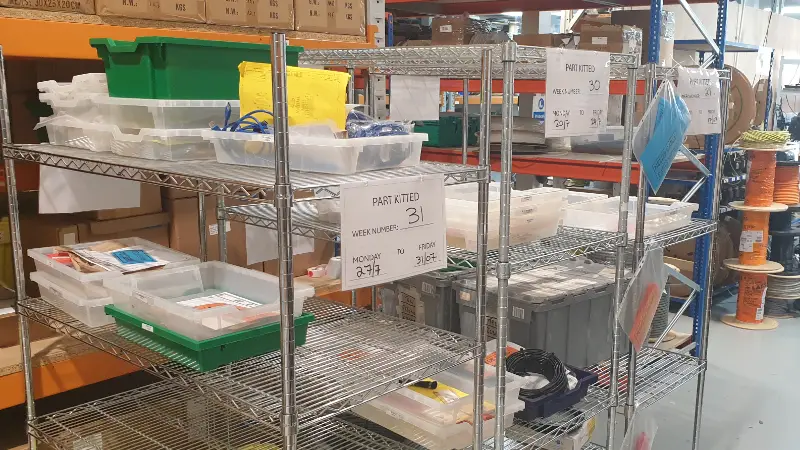
Visible Management helps identify the status of work
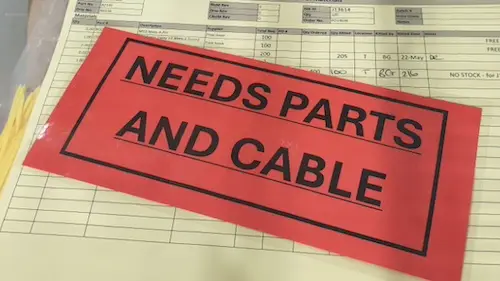
Visible Management helps identify the status of work
Key Improvements Identified
The value stream analysis identified several critical improvement opportunities, including:
- Eliminating manual stock verification by recognising the need for accurate live inventory visibility.
- Reducing excessive work in progress by integrating the cutting operation more closely with production scheduling.
- Preventing damage and unnecessary handling by improving the timing of kitting activities.
- Introducing controls to prevent production of customer orders that had been placed on credit hold.
- Establishing a Goods In calendar to improve planning and visibility for the stores function.
Alongside these operational improvements, a new production planning methodology was developed. Meaningful performance metrics, including booked hours versus planned hours, were introduced to provide realistic capacity planning, improve scheduling accuracy and highlight areas requiring corrective action.
The production layout itself was redesigned to improve workflow, reduce unnecessary movement and support continuous product flow through the factory.
A comprehensive 5S workplace organisation programme was introduced across the shop floor. Teams were encouraged to take ownership of their work areas, standardise layouts, improve tool availability and develop consistent working practices. Rather than simply implementing housekeeping activities, the programme empowered employees to identify and drive their own improvements.
The stores operation underwent a complete redesign. Layouts were reorganised around four core activities:
- Receiving incoming goods
- Kitting material for upcoming production
- Performing stock control activities
- Packing and despatching finished products
The project also resulted in the removal of significant quantities of obsolete stock, packaging and unnecessary materials, re-organisation of carousel storage and established clear ownership of the stores area. A simple but powerful principle was adopted throughout: “Stock has to earn its place on the shelf.” Slow-moving customer-owned inventory was identified for return, while obsolete stock was tagged for disposal, releasing valuable storage space and improving inventory control.
To encourage continuous improvement, the organisation introduced the concept of “Turnbacks” – any issue that prevents employees from completing their work first time. These were captured systematically and reviewed through cross-functional meetings, ensuring that problems were addressed at their root cause rather than repeatedly managed.
Finally, Visual Management techniques were implemented throughout production, providing real-time visibility of work status, production priorities and outstanding actions. This enabled quicker decision-making, improved communication and greater accountability across the business.
Nick Locke, Managing Director of Nicab, described the programme’s impact:
“The team have adopted Lean as a mindset and way of working -planning with purpose, managing workloads confidently, tracking performance, taking pride in quality and challenging themselves to improve every day.”
Results
The Lean transformation delivered significant operational improvements across the organisation, including:
- Improved production flow and reduced operational bottlenecks
- Production efficiency up from 55% to consistently above 85%
- First Time quality is stable and running at >98%
- Reduced work in progress and lower inventory levels.
- Improved workplace organisation through 5S
- More efficient stores operation with clearer ownership and accountability
- Enhanced visibility of production status through Visual Management
- A structured process implemented for identifying and eliminating operational barriers
- Greater employee engagement and ownership of continuous improvement
- Improved cross-functional collaboration between production, planning and stores
- A stronger foundation for future operational excellence and sustainable business growth
Conclusion
Rather than implementing isolated Lean tools, this programme focused on creating an integrated operating system that aligned people, processes and performance measures.
By combining Value Stream Mapping, workplace organisation, visual management, improved planning and employee engagement, the organisation established a culture of continuous improvement that delivered lasting operational benefits while positioning the business for future growth.
Still Confused About How Lean Can Help? Contact us for more information
Please contact us for more information on the benefits of applied lean consulting and what Lean can do to benefit your business.